

23·
9 months agoIs your favorite color purple?
Is your favorite color purple?

The list is short because historically it has been hard to designate domestic organizations as terrorists without violating their First Amendment rights (among others, I’m sure).
Sec. 3. General Provisions. (a) This order shall be implemented consistent with applicable law.
Glances nervously at the first amendment
You alright bud?
Why “back” of course!! I hear babies got it, so start with them.

Fair point! As far as I can tell, the temp sensors are just beacons - anyone can connect and see that somewhere in your house it’s 72 °F, but who cares ¯\_(ツ)_/¯
If you’re running on a Raspberry Pi, you can just use the onboard BT, whose drivers are updated regularly.
ZigBee ones get occasional updates automatically detected through HA, and have to be moved to somewhere near the controller to update. I assume, as temperature and humidity sensing hasn’t changed, that these are security patches.
BT ones get no updates, which either means their security goes unpatched, or it really doesn’t matter when all they do is shout out measurements into the void.
If i did mean to rape children, it’s
all of your faultstheir fault for “dressing that way” or whatever
FTFY. 100% think he’ll go the “asking for it” route like most rapists.
Of course! From an end-user the experience between Bluetooth and ZigBee sensors is basically indistinguishable, except for range.
I have a detached garage, on the opposite end of my property from my HA controller, so the Bluetooth sensor out there specifically was a little flaky. The BT sensor is rated for ~160 ft but realistically it’s 50-100 ft if your home has walls.
Swapping that one sensor to ZigBee so it could tie into my mesh network solved the problem. All other BT sensors have had zero issues, and their AA batteries unsurprisingly last longer than the 3R ZigBee AAAs, but both last at least 6mo.
Some Shelly devices can be used as “Bluetooth repeaters” but I’m unsure of the specifics of how that works.
If the screen isn’t important, Third Reality makes a slightly cheaper version with no screen that also takes AAA - conveniently on sale now
https://camelcamelcamel.com/product/B0D2NVJTS3
I have a mix of those and an old version of these Govee Bluetooth sensors that are also fully offline, take AA batteries, and pair well with HA
https://camelcamelcamel.com/product/B07Y36FWTT
Not strictly ZigBee, but cheaper, just as accurate as the 3R, and fully offline
How does adopting more progressive candidates in California solve gerrymandering in Texas?
What’s the alternative, let the red states gerrymander and then just hope and pray that our new Republican-run house does the right thing and outlaws their one advantage in governing?
Newsom isn’t doing this in a vacuum, California has had a really well liked nonpartisan districting committee. Texas and other red States have gone with the nuclear option and CA is responding in kind - even more importantly, this is something that has to be voted on by the residents of CA in a special election, rather than by a set of politicians already benefitting from gerrymandering.
I absolutely hate that it has to be done, but as a CA resident I will be voting for it, and I will be pressuring my elected representatives to work towards passing federal legislation outlawing the practice and bringing things to a more even playing field.
The do-nothing alternative is not an option.
Beginner question here - does HA even take sub-second polling?
Honestly why does it matter what they say, they’re just gonna do whatever their leader tells them when the time comes.
It’s just Kavanaugh’s “Roe v. Wade is settled precedent” all over again. Grifters gonna grift.
Last I checked, murder is still illegal in Minnesota - a pardon won’t do much to offset multiple life sentences.
Others clearly have their pitch forks ready to go but the real reason here is because they won NY. I’d be shocked if any presidential candidate in the history of the US demanded a recount in a state they won.
Is 0 votes suspicious? Absolutely. Is the recount process the right way to uncover something happening at a scale to compromise an entire district’s election process? Probably not.
According to Balletpedia, it’s unclear who in NY even pays for a voluntary recount (NY has mandatory recounts in close elections).
However suspicious this district is, it’s not justification for a recount in another district in a completely different state.
If there is interference at a meaningful scale, it’s not going to be uncovered by volunteers working without sleep to deliver election results as quickly as humanly possible. The wheels of justice turn far top slowly.
A lawsuit is a good first step.
The VPN speeds will be throttled pretty substantially, and low ram will result in some instability seeding, but it should run. Good thing about torrents is they’re built for unreliable.
I’ve run a torrent box like described on pretty much every pi generation, and the pi4 was the first one where VPN speed was no longer the bottleneck.
Got it, so just vibes… Well, since you caught me on a Friday with a light schedule…
Amperage rating is maximum load, not how much it uses the entire cycle. I just so happen to have my washer hooked up to a power meter, and look at that! It doesn’t draw the entire load during the entire cycle (which would look like a flat line)!

Runtime is not correlated with energy use. Energy is actually much more closely linked to water usage, since it takes a lot of energy to heat up all that water for a cycle, and all that water weight causes extra load on the internal motors. The additional runtime of modern washing equipment is mostly idle time to allow for additional soaking, etc. and not contributing much energy use. Historical trends show a pretty steady decline in energy use. Here’s one study that found a 75+% decrease in energy use per load from the 90’s to the early 2010’s:
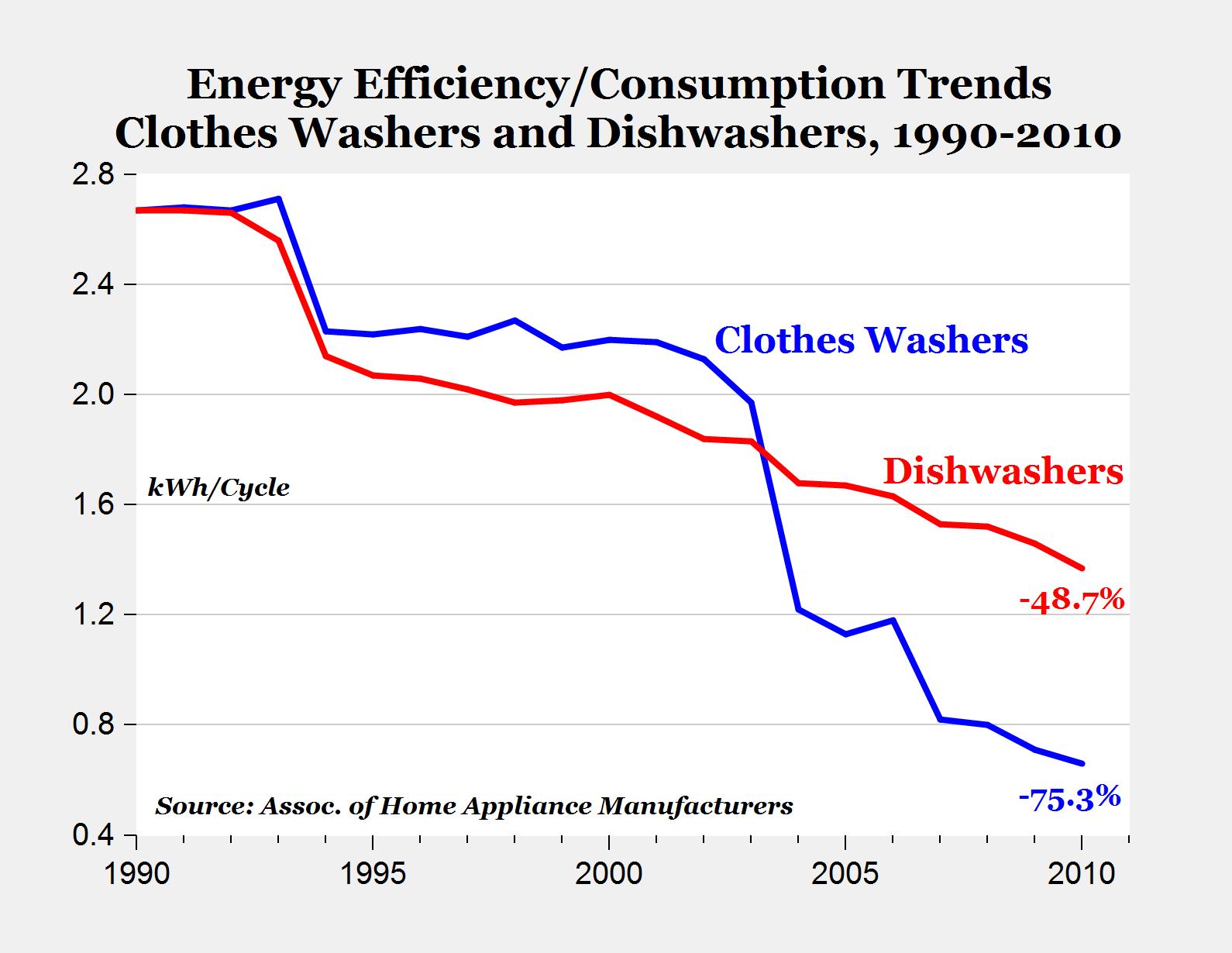
This is interesting, because when partnered with data on tub size, it actually shows that even as loads get larger, energy use has been decreasing over time:

(source is Association of Home Appliance Manufacturers again).
Back to your original comments about refrigerators, I’ll just add, going from ~1400 kWh/yr in 1980 to ~400 kWh/yr in 2014 is a 72% decrease in energy use (which is amazing), even while real appliance costs have come down AND volume has gone up.
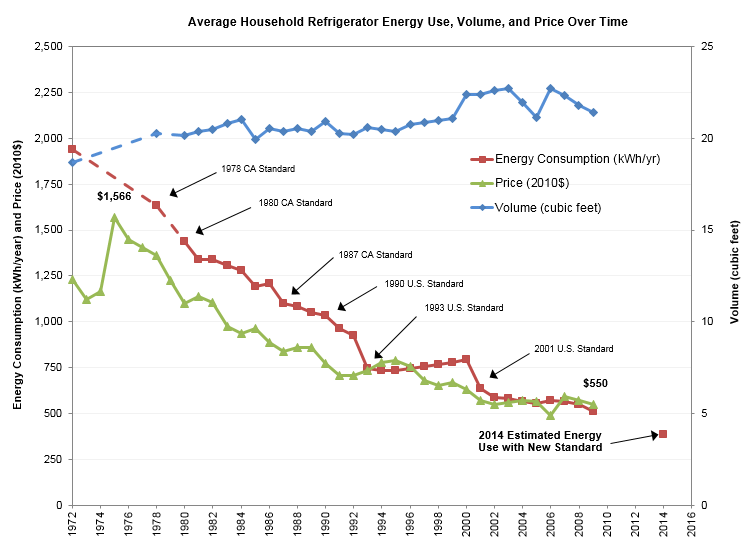
IDK where you live, but 1000 kWh/yr for me would cost ~$250 ($0.25/kWh). Swapping a 1980s fridge with a modern one would pay for itself in just 2-3 years. Hell, I could even splurge for a fancy fridge and still have a payback faster than investing in the stock market.
These gains, largely driven by regulatory efficiency targets, all benefit the consumer and the electricity grid at large. Being cranky about the fact that “they don’t make them like they used to” doesn’t change the fact that meaningful improvements have been made over time.
Got a source to back those claims up?
Are those dollar values normalized to the same year?
You going off data or just vibes, because the only thing here that feels questionable at best is your post.
Clearly you don’t understand, both sides did something I don’t like, which makes them the same
/s
I feel it’s more of a mix. Elon is in charge of breaking the government with reckless abandon, Stephen is in charge of weaponizing what’s left of the government against minorities.



Do I think he’s more likely than not the killer? Yes. Do I think that “beyond a reasonable doubt”? No, BUT I haven’t spent as much time studying the facts of the case as I hope each juror has.
Of course. With the right frame job, my cat could be found guilty of the murder.