

2·
28 days agoYes, Sakura is also a girl’s name.
I am Japansese. I’m not good at English. Mastodon: @hoagecko@fedibird.com
Yes, Sakura is also a girl’s name.
Japan: 花 (Hana, Flower), 菫 (Sumire, violet), 蓮 (Ren, lotus), 蘭 (Ran, Orchid), 柊 (Hiiragi).
While I’m not in favor of boycotting culture, I do feel like boycotting products and services that incorporate it.
So I try to buy boycotted cultural products secondhand whenever possible.
This way, I can legally obtain culture, but it prevents American companies from making any additional profits. (Naturally, I avoid using Amazon[.]com when making these purchases.)
The problem then arises when an American artist performs in the country where I live.
Naturally, experiential entertainment cannot be recorded, meaning it cannot be purchased secondhand. This issue determines whether a boycott is feasible based on how individual artists respond to corruption in the United States.
Separately, I also try to avoid cultural dependency on social media platforms such as YouTube and x[.]com by prioritizing domestic alternatives (such as Nico Nico Douga and mixi2).
In Japanese, the English phrase “12 years old” is written as ‘12歳’ or “12才”.
Both “歳” and ‘才’ are read as “sai,” and “歳” is the standard form.
As an exception, since children in elementary education typically learn the character “歳” before “才,” it is sometimes common to write ages as “12才” during the period after learning ‘才’ but before learning “歳.”
reference:
「年齢」を「年令」、「○歳」を「○才」と書くことがありますが、正式にはどうなのでしょうか?|漢字文化資料館 (Article in Japanese)
相合傘, means two people sharing one umbrella.
相合傘 has a strong romantic implication, stemming in part from a play on words. The first two characters are pronounced あい (ai), the same as the word 愛 (ai, “love”), and thus the connotation is that both people under the umbrella are in love.
This Image is Visualization of visited sites using the LightBeam Firefox extension.
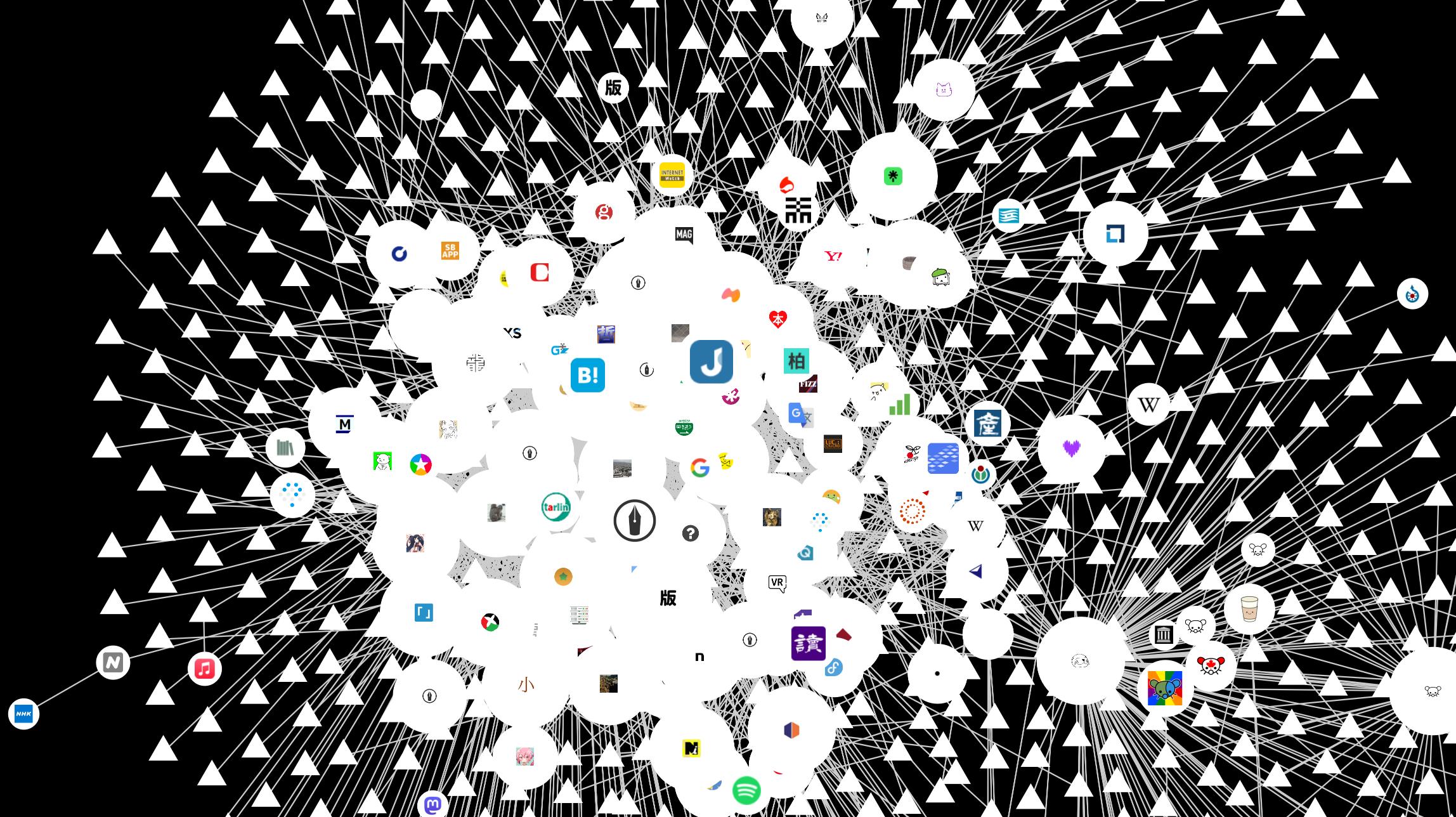
As a Japanese native, the only foreign language I studied at school was basically English.
However, as part of my ancient Japanese language education, I studied classical Chinese literature written in Chinese characters, from which hiragana and other Japanese characters are derived, so ancient Chinese might also be included in the list of foreign languages I learned.
「マンガ肉」

This is what you would call “Manga Meat” in English, an iconic piece of meat on the bone that often appears in anime, manga, games, and other works in Japanese subculture.
I would love to bite into this hearty meat like the cartoon characters someday.
(This comment uses translation software.)
Yes. I am a feminist, though I am skeptical.
Some feminists argue(Article in Japanese) that the gender equality brought about by feminism also liberates men from the suffering unique to them.
I take a similar stance, believing that the ‘gender equality’ brought about by male feminism, which seeks happiness for men, also liberates women from the suffering unique to them. In some ways, I am a reactionary feminist.
Previously, I was a male feminist with old-fashioned thinking, striving to eliminate only women’s suffering, not men’s.
However, I changed my mind after the Japanese government, where I live, adopted a policy of allocating “female admission quotas” at prestigious universities, including national universities, as part of its affirmative action program, modeled on America’s racial admission quotas.
Even back when I supported traditional feminism, I was critical of the current state of university education in Japan, where there are public women’s universities but no public men’s universities. I also believe that expanding these quotas to general universities would violate the Constitution, which proclaims gender equality. I cannot trust traditional Japanese feminism, which supports the unconstitutional status quo, and that is why I have become the skeptical feminist I mentioned earlier.
Nobuyuki Onogi: Libble Rabble (1983, AC)
Tim Follin: Puzznic (1990, Amiga)
Koichi Sugiyama: Tetris 2 + BomBliss (1991, FC)