

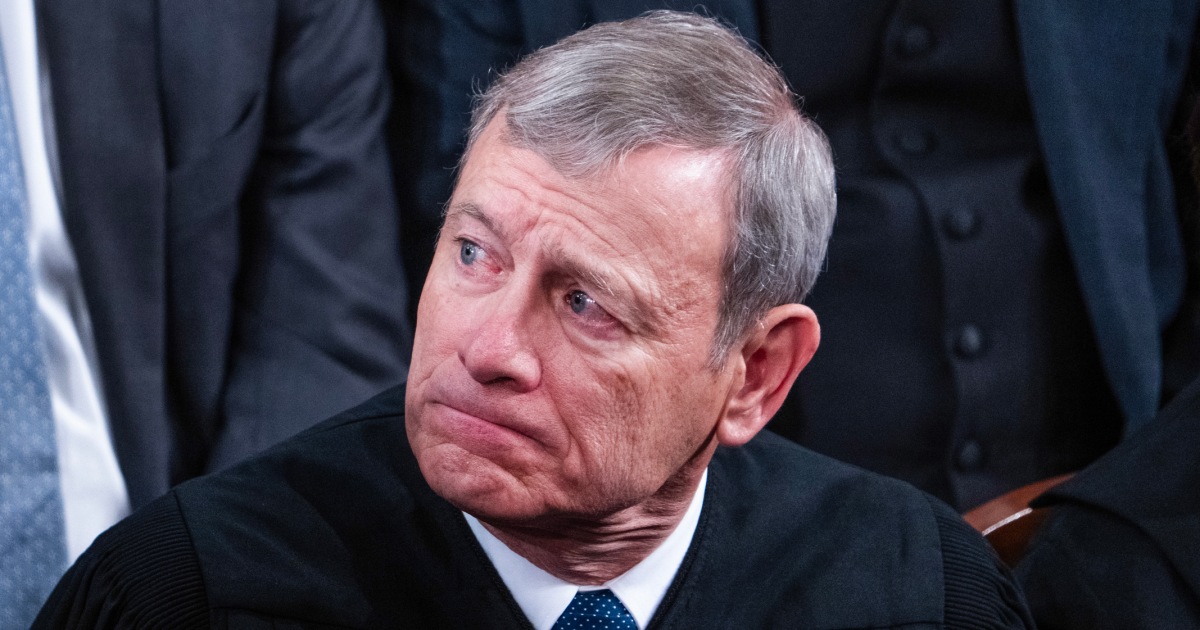
In remarks at a judicial conference, Roberts bemoaned what he characterized as the American public’s misconceptions about the Supreme Court.
Chief Justice John Roberts on Wednesday defended the Supreme Court from what he believes are misconceptions held by the American people that he and his colleagues are “political actors” who are making decisions based on policy, not law.
Roberts is a member of the court’s 6-3 conservative majority, which has moved federal law to the right on a number of weighty issues in recent years, such as abortion and gun rights.
The court has also in several cases weakened the landmark Voting Rights Act of 1965, including in a ruling last week that led to outrage and disappointment on the left.
This is pretty close to my thinking as well: just keep adding members on a set schedule; don’t fill vacated seats. (I’d add one seat at the end of the first and third year of the presidential term, to keep this process as far away from the presidential and midterm elections as possible.)
The only major difference is that I would not use emergency sessions to reconstitute the court! I would strongly isolate the court from politicization.
The foundation of my plan would be to establish a formal “line of succession” to SCOTUS. We have 13 circuit courts of appeal, each with a chief judge. Those chief judges, in order of seniority, are the first in the line of succession. Next, every other appeals court judge, in order of seniority.
Every one of these judges has been through a Senate confirmation. They are pre-approved. If every SCOTUS justice dies from a Hantavirus outbreak, the next court has already been selected, without needing to expose the court to the political process.
This line of succession offers some other possibilities as well. When it comes time to appoint a new justice, the president can name anyone they want, and the Senate can confirm. But, we can say that the first 26 (2 * number of circuit courts) in the line of succession are pre-confirmed and don’t require an additional confirmation to be named to the bench. The Senate can fairly consider the president’s preferred, younger nominee, or the president can ram one of these 26 senior candidates down the Senate’s throat. The president has a veto-proof pool of candidates that the Senate can’t play games with.
The line of succession also offers the possibility of temporary elevations for specific purposes. Suppose most/all of the justices are conflicted and forced to recuse themselves from a particular case. The line of succession allows us to elevate temporary replacement justices for this case. This would allow an ad hoc supreme court to hear cases involving, say, SCOTUS ethics.
So, not a lawyer, take this with a grain of salt, they already have a system for temporarily seating justices/federal confirmed judges on courts they normally don’t sit on. Like sick days or something? For when a judge needs to recuse themselves from a case, more realistically I imagine. Not sure how it works for scotus but the lower courts use it a lot.