

Mine is “guinea pig” originating in andes (not guinea) and them being not-a-pig type, whole thing is just wrong.
Without doubt, the turkey. Buckle up, it’s a wild ride: The North American bird is named after the Eurasian country because it reminded settlers from Europe of an African bird, the guinea fowl. Allegedly, they called the guinea fowl “turkey fowl” because it was first imported to Europe through Turkey.
That’d be crazy enough, if it stopped there. The French call it dinde, as in d’Inde, or Indian fowl, because it came from a land originally confused with India. The Dutch, though, call it kalkoen, which derives from “fowl of Calicut,” which is a city in India now called Kozhikode. Lots of other languages use a derivation of this word. Apparently, they got turkeys from India after Portuguese traders brought them from the Americas. I say Americas, because the Portuguese name is perú, a South American name that they used to refer to Spanish settlements in the Americas, generally. The Spanish, on the other hand, call the bird pavo, derived from the Latin word for peafowl, which actually are from India.
Germans, at least, call it Truthuhn, or Pute, onomatopoetic names based on the birds’ calls.
That is wild lmao thank you for this post. One of my favorite bits of etymology trivia is the phrase “comparing apples to oranges” which means a false or meaningless comparison. But in fact while we call them oranges now, they were once called apples of the orange tree and the orange tree was named before the word orange became the name of the color and then the fruit.
So in a round about way the phrase sort of takes on the opposite of its colloquial meaning.
Every moment of this was a fresh hot take.
deleted by creator
We really ought to pick one of these names to start calling them:
https://www.birdful.org/what-did-native-americans-call-turkeys/
I’d be partial to the Muscogee word because I’m from the Southeast (and because it starts with ‘t’), but it doesn’t seem like it has enough vowels so I have no idea how to pronounce it.
Geoduck
Its pronounced “gooey-duck”
Its not gooey
Its not a duck
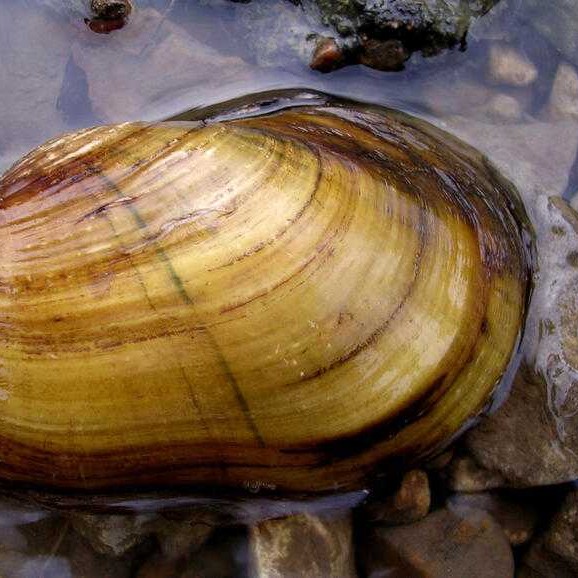
Its a clamClam expert here. It comes from the Salish word gʷidəq, a word whose exact etymology is not well understood. Why that became anglicized as “geo-”, I am not linguistically experienced enough to know!
Clam expert here
how many times have you had to explain when people expressed surprise that clam experts exist? lol
Oh, all the time!

The Salish languages mostly use a phonetic alphabet, and if I recall correctly, only one has standardized an alphabet which only happened in the 1970s. So the written word got obliterated compared to the pronunciation. The ‘ge’ is meant to sound like ‘get’. But since ‘geo’ exists, we hear and read ‘Jee-oh’ before ever thinking ‘Geh-oo’.
/former geoduck farmer and language student where geoducks were the mascot.
Best mascot ever, tied with the banana slugs!
You should go tanning.
Then you would be Dan, the tan clam man.
He should drive a van.
Eh maybe not that, careful about the tan clam man with the van
I had to google this, legitimately thought you were referring to a Pokemon or something. Some weird combination of Geodude and Psyduck, maybe.
Pineapple. Neither pine nor apple, tastes like neither.
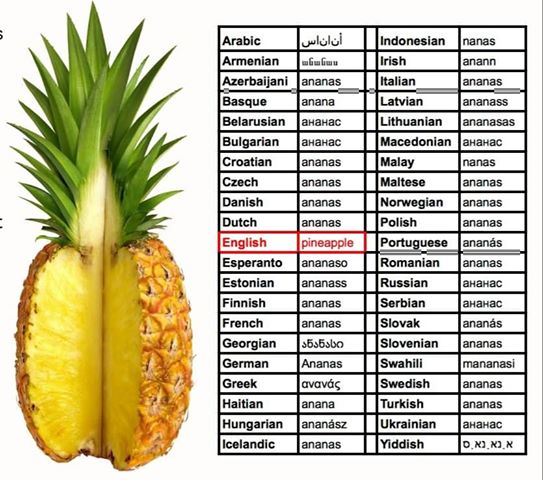
- Asturian: piña (Spain, via Latin)
- Tagalog: pinya (Philippines, via Spanish)
- Afrikaans: pynappel (Southern Africa, via Dutch like English)
- Japanese: painappuru
- Korean: painaepeul
- Welsh: pîn-afal, afal pin
- .
- Chamicuro: mawuli (Peru)
- Cherokee: notsiiYusdisvgata (USA)
- Chinese, Cantonese: bo1 lo4, fung6 lei4-2
- Chinese, Hakka: vòng-lì
- Chinese, Hokkien: ông-lâi
- Chinese, Mandarin: bōluó, fènglí, huánglí
- Dusun, Central: tintingabai (Malaysia)
- Hawaiian: hala kahiki
- Isan: bàk-nát (Thailand)
- Kaqchikel: ch’op (Guatemala)
- Khmer: mnŏəh (Cambodia)
- Lao: māk nat
- Malayalam: kaita (India)
- Melanau, Central: piseng (Malaysia)
- Nahuatl: matzahtli (Mexico)
- Ojibwe: zhingwaako-mishiimin (USA, Canada)
- Pali: kharattaca, madhuketakī, bahunettaphala (India, SL, SE Asia)
- Thai, Central: sàp-bpà-rót
- Tibetan: thang 'bras
- Vietnamese: dứa, cây dứa, thơm, cây thơm, khóm, cây khóm
Japanese: painappuru
Pain-apple
Note: While “ananás” is one name for it in Portuguese, in Brazil it’s more often called “abacaxi”, and other Portuguese-speaking countries may use both words to differentiate cultivars. Both words come from the old-tupi language a lot of indigenous peoples spoke.
It does kinda look like a pinecone, though, and “apple” just means “fruit.”
It’s actually supposed to be a “pie napple”
The English Horn is not a horn nor was it invented in England. It is a woodwind and was created in Poland (Silesia at the time). Also the French Horn was created in Germany, although it is at least a horn.
My aggressively pedantic music theory prof in college insisted that “French” was incorrectly applied to the horn and that we should instead call it the Horn in F. She did not play the horn.
Yosemite actually is a Miwok phrase meaning “those who kill”, referring either to the Ahwahnechee people who were feared by the Miwok, or to European colonizers themselves. Colonialism produces a lot of misnomers.
Duct tape.
Many uses, but should never be used on ducts.
Or ducks. For clarity.
I dunno man, some of those ducks might deserve it.
(IYKYK)
Why?
It dries out and falls off. The proper tape is aluminum tape, or foil tape.

Primodial soup. It was perfectly sterile. No organic matter in it. (didn’t exist yet.) Today’s oceans are wet cement in comparison.
The word primordial doesn’t imply anything living. It means something that came before something else. It’s the soup of organic compounds from which life originally formed.
My problem is with the word soup. Scientists don’t call today’s ocean a soup and it has many times more compounds, materials, and living matter.
Would you have preferred “primordial cereal” instead?
The squeal like pigs for food and they used to cost a guinea in UK when people first sold them as pets.
That’s apocryphal actually, according to wikipedia:
The origin of “guinea” in “guinea pig” is unclear. One proposed explanation is that the animals were brought to Europe by way of Guinea, leading people to think they had originated there.[1] “Guinea” was also frequently used in English to refer generally to any far-off, unknown country, so the name may be a colorful reference to the animal’s exotic origins.[27][28]
Another hypothesis suggests the “guinea” in the name is a corruption of “Guiana”, an area in South America.[27][29] A common misconception is that they were so named because they were sold for the price of a guinea coin. This hypothesis is untenable because the guinea was first struck in England in 1663, and William Harvey used the term “Ginny-pig” as early as 1653.[30] Others believe “guinea” may be an alteration of the word coney (rabbit); guinea pigs were referred to as “pig coneys” in Edward Topsell’s 1607 treatise on quadrupeds.[1]
They also just have lots of strange names in different languages
They also just have lots of strange names in different languages
In Polish it’s “świnka morska”, literally “sea piggy” (same in basically all Slavic and many central/north Asian languages). Though it was officially renamed “kawia domowa” few years ago because even the superconservative Polish Language Council had enough.
Left and right politics. Extreme right people don’t want rights for the people.
Porque la izquierda libera, la derecha oprime.
(We say “lefty loosey, righty tighty”, but a similar rhyming phrase in Spanish translates to “the left liberates, the right oppresses”)
And the extreme left wants rights for everyone and ensure everyone has time to sleep and hobbies, and universal healthcare! Ugh the audacity I want to go bankrupt after a visit to the hospital goddammit, that is freedom.
They are clearly the same.
Look, if I have to go bankrupt for visiting the hospital to make sure that all these “rainbow flag” groups can’t corrupt our youth, that’s what I’m going to do!
- Conservatives, probably
I will take the hit personally for my big beautiful country
They got that name because of the position of their seats in the national assembly after the French revolution. Those that were pro monarchy sat to the right, those that were opposed to the king having any say sat to the left.
From the speaker’s point of view, not their point of view. Another misnomer for a democracy.
Mistletoe.
It looks neither like mist, nor rain, nor missile, or definitely not a toe.
It’s also a parasite
Lool TIL. I remember learning the word for the first time as a kid and was just so confused.
Common sense. Much less common than the name would suggest.
There are (oh so ironically) so many to choose from in Astronomy.
Planet for example, or Asteroid…
But seriously, it’s in their name, that they name things, which, as the name’s typically used, encompasses so much more… They name themselves as that which names stars, and they cannot even get naming themselves right…
Misnomers so normalised, many people don’t even realise.
Nommy irony of astronomy.
So aster means star and asteroid means star-like, right? I get that they’re not stars, but lumps of stone and ice, but they burn when they pass by and appear to us as shooting stars, so star-like.
Or am I thinking of meteorites?
And what’s the deal with planets? That they’re not planar?
That the “stomach flu” is the same as influenza
That makes sense. It’s influenza but in the stomach
There is no such thing as stomach flu.
It’s what people call gastroenteritis.
Wait so you saying it is or it isn’t?
[CW Confession of a meat eater]
I’m in Peru and I ate a guinea pig yesterday…